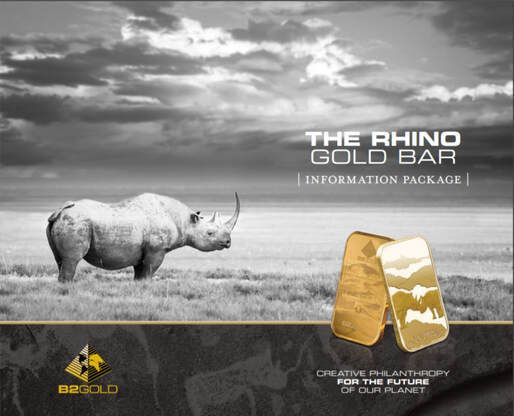
In early 2020, Canadian miner B2Gold did something unusual with metal from its Otjikoto Mine in north-central Namibia. Instead of selling 1,000 ounces of gold into the ordinary market, it minted the metal into a limited run of Namibian Rhino Gold Bars and sold them to raise money for the people who protect the country’s last free-roaming black rhinos. The idea was simple and unusual at once: use one scarce Namibian resource to defend another.
North-west Namibia is home to the last and largest population of desert-adapted black rhinos that still live unfenced on communal land. There are fewer than 5,630 black rhinos left in the wild worldwide. Poaching for horn remains the main threat, and the animals range across roughly 25,000 square kilometres with no national-park status and no fences. Their security depends on community trackers and rhino rangers, whose work also underpins local tourism jobs. When that work stops, both the rhinos and the rural economy around them are at risk.
The concept came from wildlife filmmaker and Save the Rhino Trust Namibia board member Ginger Mauney, who wanted B2Gold’s existing support for rhino work to become a lasting fund rather than a series of cash grants. B2Gold approved the donation in 2019. The gold was refined and struck by Rand Refinery, an LBMA-accredited producer, as 1,000 bars in three sizes: ten 500-gram bars, 690 one-ounce bars and 300 half-ounce bars. One face shows a rhino cow and calf; the other carries a Namib desert or Etendeka mountain motif and the refinery mark. Bars were sold at the spot price of gold plus a 15 per cent conservation premium.
Launch events in Windhoek and at the Mining Indaba in Cape Town sold the first large bars within days. Later in 2020, Kitco offered the North American one-ounce issue and processed sales at cost. The full inventory sold out within months and generated about US$1.7 million. B2Gold president and chief executive Clive Johnson put the logic plainly: the company was mining gold deposited in Namibia hundreds of millions of years ago and using it “to save an animal that has been roaming the planet for 50 million years.”
Proceeds did not go into a single grant. A share was invested for long-term financing; the conservation premium was meant to reach the field quickly. An advisory committee — B2Gold, Save the Rhino Trust Namibia, Integrated Rural Development and Nature Conservation (IRDNC), the Namibia Chamber of Environment, and the Ministry of Environment, Forestry and Tourism — decides how money is released. B2Gold’s own site records US$230,000 disbursed in 2020. In 2021 a further US$256,861 went to SRT, IRDNC and conservancies, the Namibia Nature Foundation, Friends of Namibia Conservation Trust and Ultimate Safaris. Country manager John Roos has since said that, from 2020, around US$850,000 has been distributed to anti-poaching work in the north-west.
The timing mattered. Covid-19 emptied the tourism lodges that had helped pay ranger salaries. The fund stepped in and kept people on patrol for two years. That, Roos has argued, is what “boots on the ground” actually means when visitors disappear: salaries paid, vehicles bought, intelligence work continued. SRT chief executive Simson Uri-Khob said the North American sale came when conservation funding was already under strain and wild rhinos were at “serious risk.”
The initiative was never only a souvenir. B2Gold and its partners described it as a first attempt to turn mined gold into a revolving conservation finance tool, with later rhino-themed bars or medallions intended to keep the fund growing. Whether a second mintage proceeds or not, the first run did two things at once: it created a collectable with a clear Namibian story, and it put cash behind community rangers in the one landscape where black rhinos still roam without fences. For SRT and the conservancies of Kunene and northern Erongo, that combination — metal from Otjikoto, oversight by Namibian partners, money into tracking and tourism livelihoods — is the practical argument for why the bars were minted at all.