

Facts About Black Rhinos
- Scientific name: Diceros bicornis
- Common name: black rhino / black rhinoceros
The black rhinoceros is one of Africa’s two living rhino species, and the only surviving member of its genus. Despite the English name, its skin is grey to brown; “black” is usually explained as a contrast with the square-lipped white rhino, or as a reference to the dark mud that coats the animal after it wallows. What truly sets the species apart is a pointed, prehensile upper lip — a hook that strips leaves, twigs and succulents from woody plants. The IUCN lists Diceros bicornis as Critically Endangered.
As recently as the 1960s, black rhinos still numbered in the tens of thousands across eastern and southern Africa. Poaching for horn, together with the loss of habitat, drove the species to a low of a little over 2,400 animals in 1995. Numbers have since more than doubled, to more than 6,000 in the wild, but the recovery is uneven and fragile. Namibia remains a global stronghold for the species — including the last truly free-roaming, desert-adapted black rhinos, which live without fences on communal land in the north-west.
Physical Characteristics
Metric
- Height: 1.4 - 1.7 m
- Length: 3.0 - 3.8m
- Weight: 800 - 1,350 kg
Imperial
- Height: 4.5 - 5.5 ft
- Length: 10 - 12.5 ft
- Weight: 1,750 - 3,000 lbs
An adult black rhino stands about 1.4 to 1.7 metres at the shoulder and measures 3.0 to 3.8 metres from head to rump. Weight typically falls between 800 and 1,350 kilograms, with cows smaller than bulls. Two horns of keratin grow from the snout: the front horn is the longer, usually around 50 centimetres and exceptionally more than a metre; the rear horn is shorter. Unlike antelope horns, they have no bony core and are not shed.
The species is a dedicated browser. That hooked lip, a relatively small head held high, and a compact body are all suited to feeding in thicket and scrub rather than grazing short grass. Thick, folded skin protects against thorns; dust and mud baths help with heat and parasites. Black rhinos can run at more than 50 kilometres an hour, on their toes, and will charge when they feel threatened.
They are largely solitary. The strongest bond is between a cow and her calf, which is born after a gestation of about 16 months and may stay with her for two to three years. Sight is modest compared with hearing and smell, which are acute. In the wild a black rhino may live 30 to 35 years. In the arid north-west of Namibia, individuals range over large home areas, following water, browse and the same ancient trails used by elephant.
Phylogeny
-
Rhinocerotidae
-
Elasmotheriinae
-
🪦 Siberian unicorn Elasmotherium sibiricum
-
-
Rhinocerotinae
-
-
White rhinoceros Ceratotherium simum
-
Black rhinoceros Diceros bicornis
-
-
-
-
🪦 Woolly rhinoceros Coelodonta antiquitatis
-
🪦 Merck’s rhinoceros Stephanorhinus kirchbergensis
-
-
Sumatran rhinoceros Dicerorhinus sumatrensis
-
-
Javan rhinoceros Rhinoceros sondaicus
-
Indian rhinoceros Rhinoceros unicornis
-
-
-
-
Rhinos belong to the odd-toed ungulates, the same order as horses and tapirs. Within the family Rhinocerotidae, living and recently extinct species fall into two subfamilies. Elasmotheriinae is represented here by the Siberian unicorn, Elasmotherium sibiricum, a giant Ice Age grazer with a single horn that died out in the late Pleistocene. All five living rhinos, and several of their Ice Age cousins, belong to Rhinocerotinae.
Genomic work has shown that the two African species — the black rhino and the white rhino (Ceratotherium simum) — are each other’s closest living relatives. Their lineages split around seven million years ago. After that split, black rhinos evolved as browsers with a hooked lip and a high head carriage, while white rhinos became bulk grazers with a wide, square mouth. The African pair sits as a sister group to the remaining rhinocerotines.
Those remaining lineages divide again. One clade links the living Sumatran rhino (Dicerorhinus sumatrensis) with two extinct Ice Age species, the woolly rhino (Coelodonta antiquitatis) and Merck’s rhino (Stephanorhinus kirchbergensis). The other pairs the one-horned Javan rhino (Rhinoceros sondaicus) with the greater one-horned, or Indian, rhino (Rhinoceros unicornis). Of the five species still alive, three are Asian and two are African; all five are threatened, and the black rhino remains among the most at risk.
Current Distribution Range
Black rhinos once occupied a broad belt of savanna, thicket and dry woodland from the Horn of Africa through East Africa into the Cape. They were never animals of closed rainforest, but they did use habitats as different as montane forest and the Namib’s desert fringe. By the late twentieth century that range had collapsed into scattered pockets, most of them inside parks, conservancies and private reserves.
The crash was swift. Between about 1960 and 1995 the continental population fell by more than 95%, driven above all by poaching for horn. The western black rhino (D. b. longipes) was declared extinct in 2011. Three subspecies remain: the eastern black rhino (D. b. michaeli), the south-central black rhino (D. b. minor), and the south-western black rhino (D. b. bicornis), the arid-adapted form that includes Namibia’s desert rhinos.
Today the species survives mainly in Namibia, South Africa, Kenya, Zimbabwe and Tanzania, with smaller reintroduced populations in countries such as Botswana, Malawi, Zambia, Rwanda and Eswatini. Namibia and South Africa together hold the majority of animals. Namibia is the stronghold of D. b. bicornis, a subspecies assessed as Near Threatened — a rare conservation success nested inside a species that is still Critically Endangered.
The Kunene and northern Erongo regions of north-west Namibia are unique even within that picture. Here, desert-adapted black rhinos still roam across some 25,000 square kilometres of unfenced communal land — no national park boundary, no enclosure, and no control over who enters or leaves. It is the last place on Earth where the species lives in this way.
The Importance of Protecting the Black Rhino
Black rhinos are more than a symbol of African wilderness. As large browsers they shape thicket and woodland, opening paths, pruning woody plants and dispersing seeds — work that other herbivores cannot do at the same scale. When they disappear, the vegetation changes, and with it the animals that depend on that mosaic of browse and shade. Protecting them is a way of keeping whole dryland systems intact.
They also carry cultural and economic weight. In north-west Namibia, free-roaming rhinos draw visitors onto communal conservancy land, supporting guiding, lodges and local employment. Where communities see a living rhino as more valuable than a dead one, the incentive to report poaching, keep cattle out of key habitat and train rangers is real. That bargain only holds if the animals remain, and if the people who live beside them share in the benefit.
Since 1982, Save the Rhino Trust has been the organisation mandated to monitor and help protect these desert-adapted black rhinos in Kunene and northern Erongo. Working with the Ministry of Environment, Forestry and Tourism, the Namibian Police, communal conservancies and Traditional Authorities, SRT puts local trackers and community rhino rangers in the field year-round — on foot and by vehicle across unfenced communal land — to find individual animals, record their condition and keep a deterrent presence in country where there are no park gates. That combination of daily monitoring and community benefit is what has given this last free-roaming population a chance to persist.

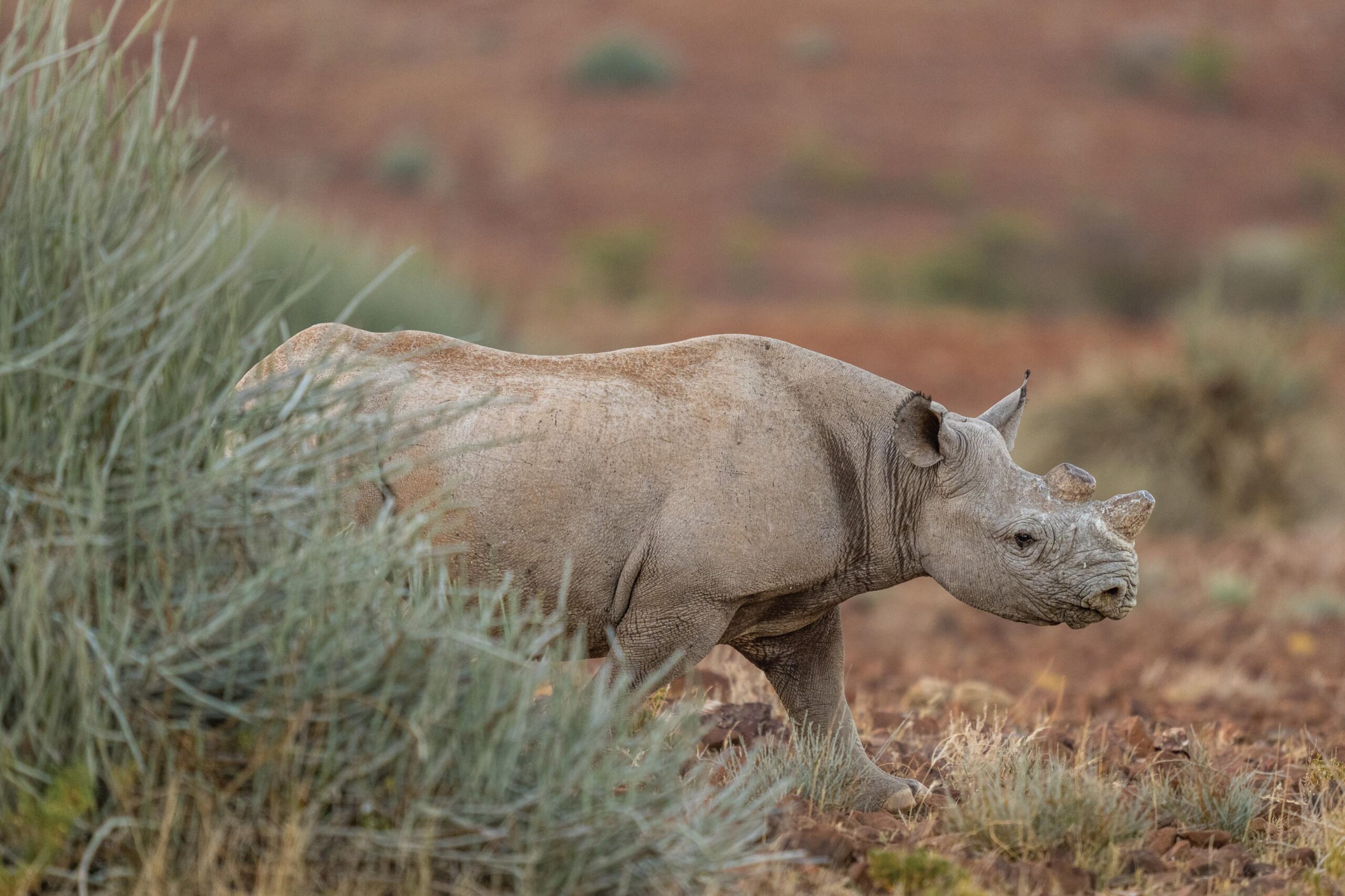
- Marcus Westberg
The photographs on this page were made in that north-western landscape: open gravel plains, red hills and sparse browse, with cows and calves moving through it as they have for millennia. These are south-western black rhinos, the most arid-adapted form of the species. They can go days without drinking when succulent plants hold enough moisture, and they know the springs, riverbeds and shade that make the desert liveable.
A calf stays close to its mother, learning the range before it is weaned and, later, before it disperses. In a population this small and this exposed, every birth matters. Drought can suppress calving for years; a single poaching incident can erase an animal that rangers have followed for a decade. The work of keeping these rhinos on the land is slow, local and unfinished.
What remains is still remarkable: a critically endangered mammal living wild, unfenced, on communal ground, known individually to the people who share the same hills. That is the black rhino Namibia still has — and the one this generation is responsible for passing on.

Facts About Black Rhinos
The black rhino is a critically endangered hook-lipped browser. Namibia remains a global stronghold — including the last free-roaming, desert-adapted animals, which live without fences on communal land in the north-west.

The Rhino Protector: Simson Uri-Khob
From welder and mechanic to CEO of Save the Rhino Trust: Simson Uri-Khob’s 32-year journey protecting Namibia’s last free-roaming desert-adapted black rhinos. A story of tracking, community rangers, and a promise that these animals will still be here for the next generation.

The Man Who Walks with Rhinos
A broken-down vehicle on a Sunday led welder Simson Uri-Khob into the desert with Namibia’s last free-roaming black rhinos. Over 32 years he went from tracker to CEO of Save the Rhino Trust—walking the land, training community rangers, and fighting to keep these animals alive so his children never have